Hair transplantation presents a critical choice: one session or two? Some patients want everything done in one operation; others prioritize graft quality over speed. High density single session grafting sits at the intersection of these priorities. The advantages are clear, but so are the risks.
- Single session high density: 4000+ grafts in one operation, complete completion.
- Time savings: Instead of waiting 12-18 months, results begin immediately.
- Donor risk: Over-harvesting and donor area damage are possible.
- Graft quality: Intense extraction increases transection risk.
- Candidacy: Good donor density, experienced surgeon, and patient readiness are essential.
- Optimal donor: 100-120 grafts/cm² density; 4000-4500 grafts is the ideal range.
What Is High Density Single Session Grafting?
High density single session grafting is the extraction and transplantation of 4000 or more follicular units in a single operation. This isn't an "extension" of standard hair transplantation—it's an entirely different strategy.
Classic approach: First session 2000-2500 grafts, six months rest and donor recovery, then second session 2000-3000 grafts. Total timeline: 12-18 months.
Single session high density: All these variables compress into one operation. This saves time but multiplies surgical intensity.
Advantages: Why Some Surgeons and Patients Choose It
1. Time: One Operation, One Recovery Timeline
Against two sessions, the biggest advantage is: no waiting. Your patient doesn't wait 12-18 months; results begin after one operation. After recovery and telogen shedding, graft emergence starts. By month 6, 50% growth is visible; by month 9, 75%; by month 12, 90%+.
2. Donor Area: Single Trauma Zone
With two sessions, the donor area experiences trauma twice. First session: bleeding, scabbing, healing—then second session opens it again. Single session means one trauma, one healing cycle. Some patients appreciate this physical relief.
3. Psychological Benefit: Sense of Completion
The hardest part of hair transplantation is waiting. Especially the first three months are grueling. Patients choosing high density single session experience a "once it's done, results begin" mindset. They escape the stress of planning a second session.
Risks and Limitations: The "Speed Cost"
1. Donor Area Damage: Severity and Permanence
Extracting 4000+ grafts in one session puts the donor area under intense stress. Linear scars may be more pronounced; alopecia cicatricialisrisk (permanent thinning in harvested zones) increases. Even patients with good donor density can see persistent thin areas after aggressive extraction.
Critical threshold: Donor density must be at least 100-120 grafts/cm², ideally 130+ grafts/cm². Below this density, single session high density causes permanent donor damage.
2. Graft Quality: Transection and Dead Grafts
Fast extraction (1200-1500 grafts/hour) invites error. Punch angle varies, blade depth becomes inconsistent, hair shafts break (transection). Extraction errors compound with intra-operative mishandling (telefindens damage during placement).
Result: Graft survival rates may drop from 90-95% to 80-85%. In other words, 4000 planted grafts might yield 200-400 dead grafts. When standard FUE delivers 90-95% rates, this loss is noticeable.
3. Recovery Difficulty: Intense Accommodation
First 10-14 days involve intense bleeding and scabbing. Patients can't wear hats (graft risk), sunbathe (infection), and experience pain and numbness. Psychologically, this period is harder than the first session of a two-session approach.
Optimal Graft Count: Where Is the Single Session Limit?
In hair transplantation strategy, "how many grafts?" is the core question. For single sessions, where is this line?
3000-4000 grafts: Safe zone. Donor damage is manageable, graft quality consistent. Most surgeons consider this the "consider single session" range.
4000-4500 grafts: Optimal. With donor density 120+ grafts/cm² and surgeon experience, this range is achievable single session. Graft quality may dip slightly, but success is likely.
5000+ grafts: Risky. Donor area suffers permanent damage, graft quality significantly drops. Most surgeons view this as the "two sessions mandatory" zone.
Who Is a Good Candidate? Patient Selection Criteria
High density single session success hinges 70% on patient profile. Even perfect surgical technique fails with wrong patient selection.
IDEAL PATIENT PROFILE:
- Donor density 120+ grafts/cm²: Essential. Lower density means immediate two-session planning.
- Norwood III-IV stage: Clear areas to address, sufficient donor supply. Norwood VI-VII may require more sessions, leading to psychological dissatisfaction.
- Intolerance for waiting: If the patient says "results now," that itself is a risk factor. Realistic expectations are mandatory.
- Recovery readiness: Must accept 2-3 weeks of social withdrawal, pain, and visible healing.
- Surgeon experience: High density single session isn't for mid-level surgeons. Require 5000+ procedure experience and 85%+ graft survival rates.
- Conservative design: "Norwood VII to Norwood I in one session" expectations are unrealistic. Design must be conservative.
NOT A CANDIDATE:
- Donor density below 100 grafts/cm²
- Psychiatric history (waiting stress adds psychological burden)
- Infection or wound-healing risk (diabetes, immunosuppression)
- Unrealistic expectations ("completely bald to fully dense")
- Insufficient donor supply for desired coverage
Critical Success Factors
1. Donor Density Mapping
Pre-op mapping measures donor area density per mm². "High density zones" are harvested first; low density areas are protected. This strategic approach preserves donor aesthetics.
2. Extraction Time Efficiency
4000 grafts require 7-8 hours of operation. Beyond this, surgeon fatigue increases errors. Adequate assistants, sterile and temperature-controlled environment, and sharp, ready instruments are critical.
3. Graft Preparation Quality
Extracted grafts wait 4-6 hours in cold saline. At cellular level, this time is critical. Prevention of desiccation and maintaining temperature are essential.
4. Post-Op Patient Compliance
Non-compliant patients magnify risks. Avoiding contact, hat-wearing, proper sleep position, and washing technique—every detail matters.
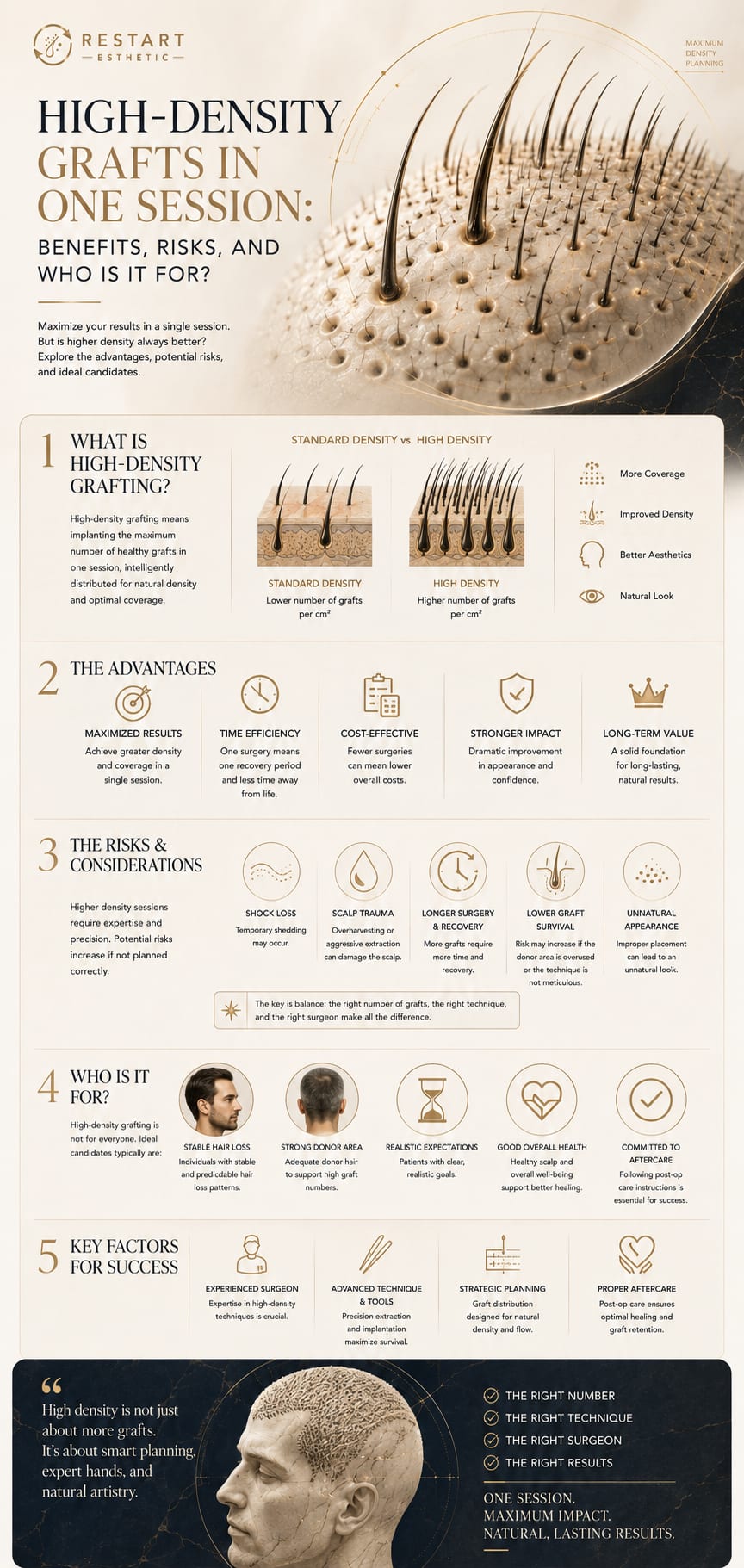
"High density single session delivers fast results, but at a cost—to donor area, graft quality, and recovery. Right patient selection means clear gain; wrong selection guarantees regret."Restart Esthetic Editorial
Frequently Asked Questions
How many grafts can be extracted in one session?
Can high density grafting be done in one session?
Can 5000 grafts be done in one session?
How long is recovery after single session high density grafting?
What do I gain by choosing one high density session over two sessions?
Can I wear a hat after single session high density grafting?
Is High Density Single Session Right for You?
Donor profile, expectations, and surgeon experience determine candidacy. AI Hair Lab offers personalized hair analysis, revealing realistic options—one session, two sessions, or hybrid approach.
Start AI Hair Lab