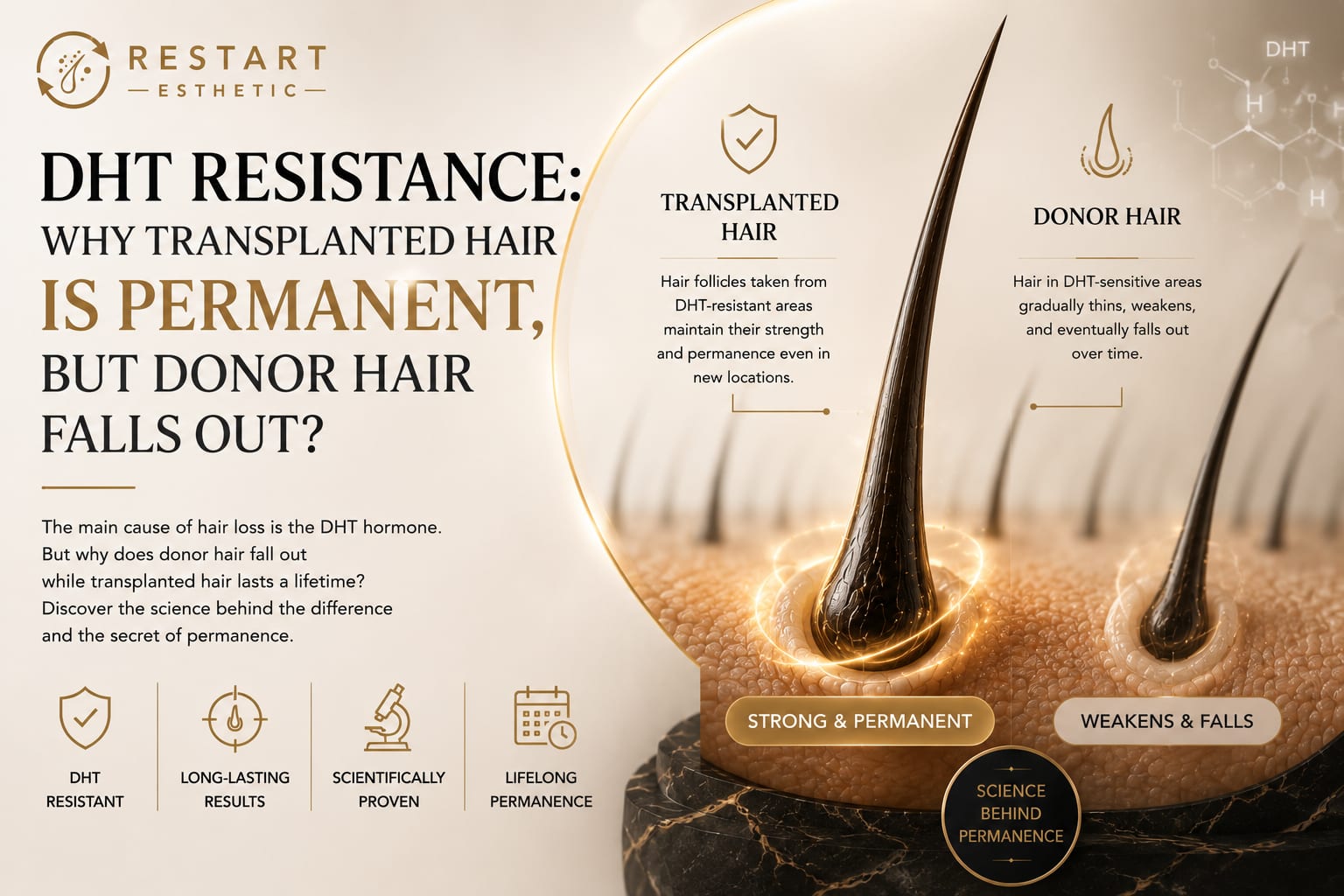
Hair transplantation science rests on a biological fact: transplanted hair retains the genetic characteristics of its origin. But why? The answer lies in DHT resistance and "genetic memory"—the follicle's inherent memory of where it came from.
- DHT resistance: Donor-area follicles are genetically resistant to DHT.
- Genetic memory: Hair follicles retain their origin's genetic information.
- Androgenetic alopecia: Male-pattern baldness results from DHT + genetic susceptibility + time.
- Occipital resistance: Donor-area hair is naturally resistant to DHT; never succumbs to male-pattern loss.
- Permanence guarantee: 95-99% of transplanted hair remains permanent for life.
Hair Transplantation's Fundamental Paradox
You've likely seen advertisements claiming "95-100% success" or "permanent results" for hair transplants. But this is not just marketing—it's biological fact. Why? Because transplanted hair carries the genetic resistance of its origin.
DHT: The Hormone and Its Mechanism
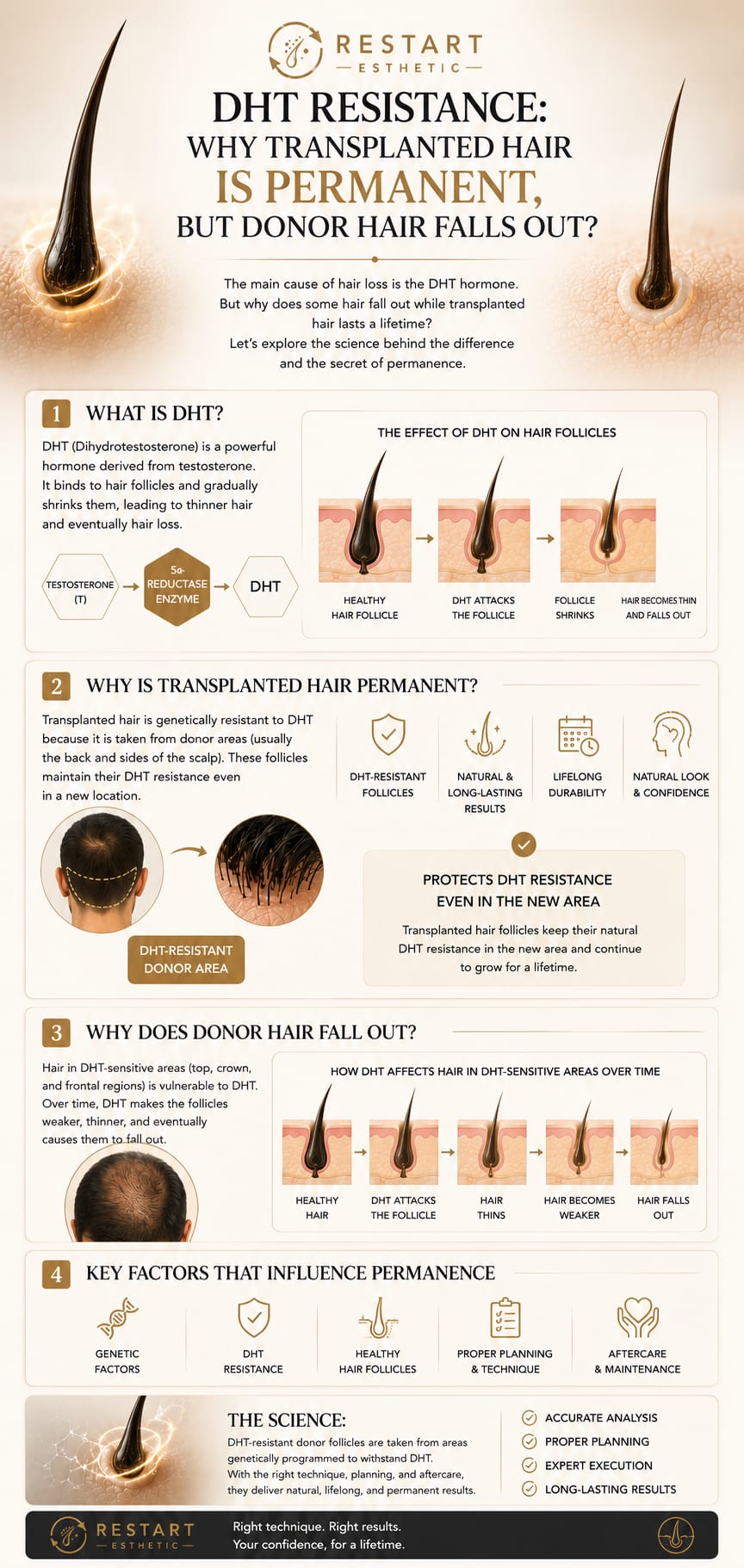
DHT (dihydrotestosterone) is an androgen hormone derived from testosterone. Testosterone is converted to DHT by the 5-alpha reductase enzyme. DHT's effects on hair follicles depend on genetically determined androgen receptor (AR) sensitivity.
This sensitivity varies even within the same individual—the occipital region (back of the scalp) has low DHT sensitivity, while frontal/temporal regions have high DHT sensitivity. This explains why male-pattern baldness follows a predictable pattern.
Androgenetic Alopecia: Hormones Meet Genetics
Male-pattern baldness results from three factors combining:
- DHT hormone: The androgen derived from testosterone
- Genetic susceptibility: Androgen receptor sensitivity levels
- Time: Years of chronic exposure
Genetic susceptibility works through DNA variations in the androgen receptor gene. These variations determine how sensitive the AR protein is to DHT. Higher sensitivity = more hair loss. Lower sensitivity = hair preservation.
The occipital region is genetically programmed for DHT resistance—follicles there have lower androgen receptor sensitivity. This is why donor-area hair is naturally protected from male-pattern baldness.
Occipital Resistance: The Origin of Permanence
Occipital (back) follicles are genetically resistant to male-pattern baldness. This resistance stems from lower DHT sensitivity in that region's androgen receptor genes. Clinically, this explains why the Norwood Scale shows progressive loss in frontal/vertex zones while occipital hair remains untouched.
Genetically, occipital follicles carry AR gene structures with lower DHT sensitivity. This programming persists throughout life and is preserved during transplantation.
Genetic Memory: The Follicle's Origin History
Hair follicles carry "genetic memory"—information about their anatomical origin. This is managed by dermal papilla (DP) cells, the follicle's most critical component. The DP regulates androgen receptor gene expression levels.
When a patient receives hair transplants from resistant donor tissue, the follicle's dermal papilla cells migrate to the new location while maintaining their AR expression "memory." This is why transplanted hair retains permanent status even in previously balding zones.
The mechanism: DP cells control AR gene expression based on the follicle's genetic origin. After transplantation, DP cells maintain that original expression level—so DHT resistance is preserved in the new location.
"DHT resistance is a biological property of donor-area tissue. Transplanted hair retains its origin's genetic characteristics—remaining permanent even in its new location."Restart Esthetic Editorial
Clinical Implications and Permanence
Clinically, this knowledge is crucial: transplanted hair survives at 95-99% rates for life. This is not marketing—it's biological guarantee.
Non-transplanted hair (remaining balding zones) continues to follow the patient's native genetic pattern. Frontal and vertex zones may continue thinning based on the patient's genetic susceptibility. This occurs because those regions carry high DHT sensitivity and remain unprotected.
DHT resistance is your transplant's biological guarantee
Transplanted hair persists because it retains genetic memory. AI Hair Lab doesn't offer personalized recommendations, but provides foundational knowledge for your specialist consultation.
Start AI Hair Lab