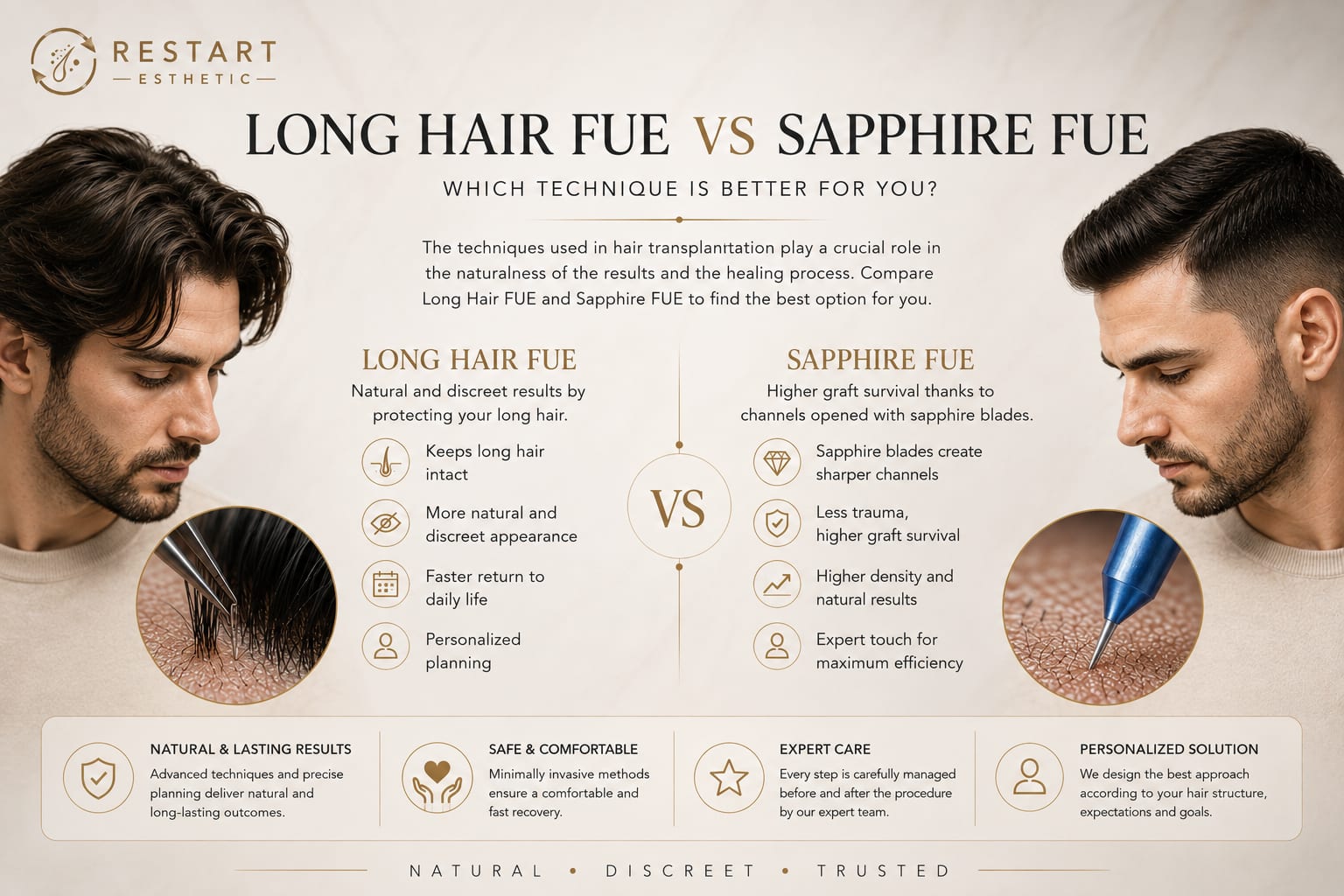
Hair transplantation technology is evolving rapidly. Today, patients face numerous options: Sapphire FUE, Long Hair FUE, motorized FUE, manual FUE, hybrid approaches — each with distinct advantages and limitations. The natural question becomes: which technique is right for you?
- Sapphire FUE: Technology + precision focus; marginal clinical difference; higher cost.
- Long Hair FUE: Immediate donor aesthetics + psychological benefit; technically more challenging.
- Real difference: Surgeon experience and technique matter more than blade material.
- Patient selection: Donor quality, expectations, lifestyle determine which technique suits best.
- Hybrid approach: Some surgeons combine both techniques for optimal results.
The FUE Techniques: Overview
Long Hair FUE and Sapphire FUE are two significant variations of modern hair transplantation. One focuses on donor area aesthetics (and patient psychology), the other on graft quality and surgical precision. Which you choose depends on patient profile, donor quality, and surgeon experience.
Sapphire FUE: Technology and Mechanism
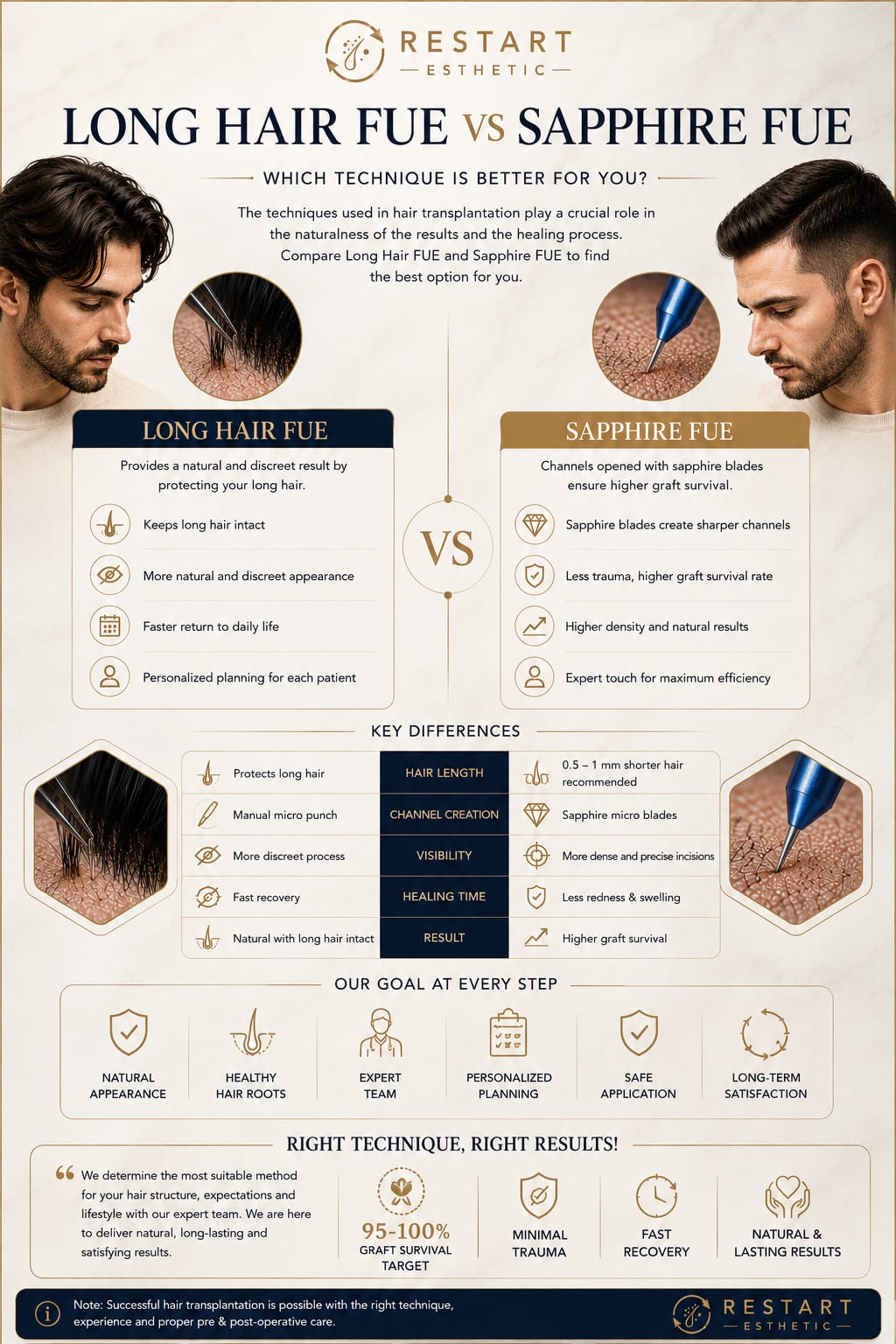
Sapphire FUE uses sapphire (ruby) blades during extraction. Sapphire is harder than steel and maintains sharper edges longer. The theory: a sharper blade creates cleaner follicle unit cuts, reducing micro-trauma.
The mechanism works like this: During extraction, a small punch separates the donor follicle. Using a sapphire punch instead of steel punch results in cleaner cutting lines and potentially less cellular damage. Sapphire's thermal properties (heat management) also offer therapeutic potential.
The theoretical advantages are compelling. However, clinical studies show marginal differences. Well-performed classical FUE achieves graft survival rates (90-95%) similar to Sapphire FUE. The real difference lies in procedural precision and operator experience.
Long Hair FUE: Donor Area Aesthetics
Long Hair FUE involves performing extraction while keeping donor area hair long (not short-cut). Classical FUE requires cutting donor hair to 1-2 mm (leaving bare donor area). Long Hair FUE keeps hair at 5-10 mm or longer.
The psychological and aesthetic impact is immediate: After extraction, the patient's donor area isn't completely bare; long hair camouflages the extraction zone. Patients feel more confident and can return to social activities immediately.
Technically, Long Hair FUE is more challenging. Long hair creates tangling, poor visibility, and graft-handling risks. Surgeon experience is critical; otherwise, transection rates increase significantly.
Sapphire FUE Advantages
- Potentially lower transection: Sharper sapphire blades enable cleaner follicle cuts and reduced cellular trauma.
- Channel precision: When creating recipient-site channels, sapphire blades produce smoother, more controlled channels.
- Minimal tissue trauma: Sharper edges mean less lateral trauma during cutting.
- Aesthetic improvements: Some studies report higher graft viability with Sapphire FUE.
Sapphire FUE Limitations
- High cost: Sapphire equipment and punches are far more expensive than steel.
- Marginal clinical difference: In controlled studies, the survival difference between Sapphire and classical FUE is marginal.
- Learning curve: Sapphire equipment differs from what surgeons typically use, extending the initial learning period.
- Over-marketing risk: The technology's advantages are sometimes overstated, raising patient expectations unrealistically.
Long Hair FUE Advantages
- Immediate donor aesthetics: Long hair immediately camouflages the extraction zone.
- Psychological benefit: Increased self-confidence and immediate aesthetic satisfaction improve compliance.
- Minimal lifestyle disruption: Hidden donor area reduces patient concerns and recovery anxiety.
- Technical parity: When performed skillfully, Long Hair FUE achieves graft quality identical to classical FUE.
Long Hair FUE Limitations
- Technical difficulty: Long hair creates tangling, poor visualization, and handling complications requiring surgeon expertise.
- Extraction time increases: Detangling and extracting long hair takes considerably more time than classical FUE.
- Graft damage risk: Tangled hair during extraction can cause follicle bulb damage, increasing transection rates.
- Surgeon selection critical: Long Hair FUE success depends entirely on the surgeon's experience and skill level.
"Sapphire FUE and Long Hair FUE solve different concerns. One aims to optimize graft quality through technology; the other addresses the patient's immediate psychological and aesthetic needs. Which is 'better' depends on patient profile and expectations."Restart Esthetic Editorial
Which Technique Is Right for You?
Ideal Sapphire FUE Patient Profile:
- Marginal or borderline donor quality
- Strong desire to optimize graft quality
- Time not a primary concern
- Adequate financial capacity
- Surgeon experienced in Sapphire FUE
Ideal Long Hair FUE Patient Profile:
- Good-quality, dense donor hair
- Immediate donor aesthetics critical
- Psychological factors important
- Desire to minimize lifestyle disruption
- Surgeon experienced in Long Hair FUE
Hybrid Approach:
Some surgeons combine both techniques: First session with Sapphire FUE (optimize graft quality), second session with Long Hair FUE (deliver immediate aesthetic benefit).
FUE technique selection is where surgical precision begins
Sapphire or Long Hair FUE — the choice depends on donor quality, patient expectations, and surgeon expertise. AI Hair Lab doesn't offer personalized recommendations, but provides foundational knowledge for your specialist consultation.
Start AI Hair Lab