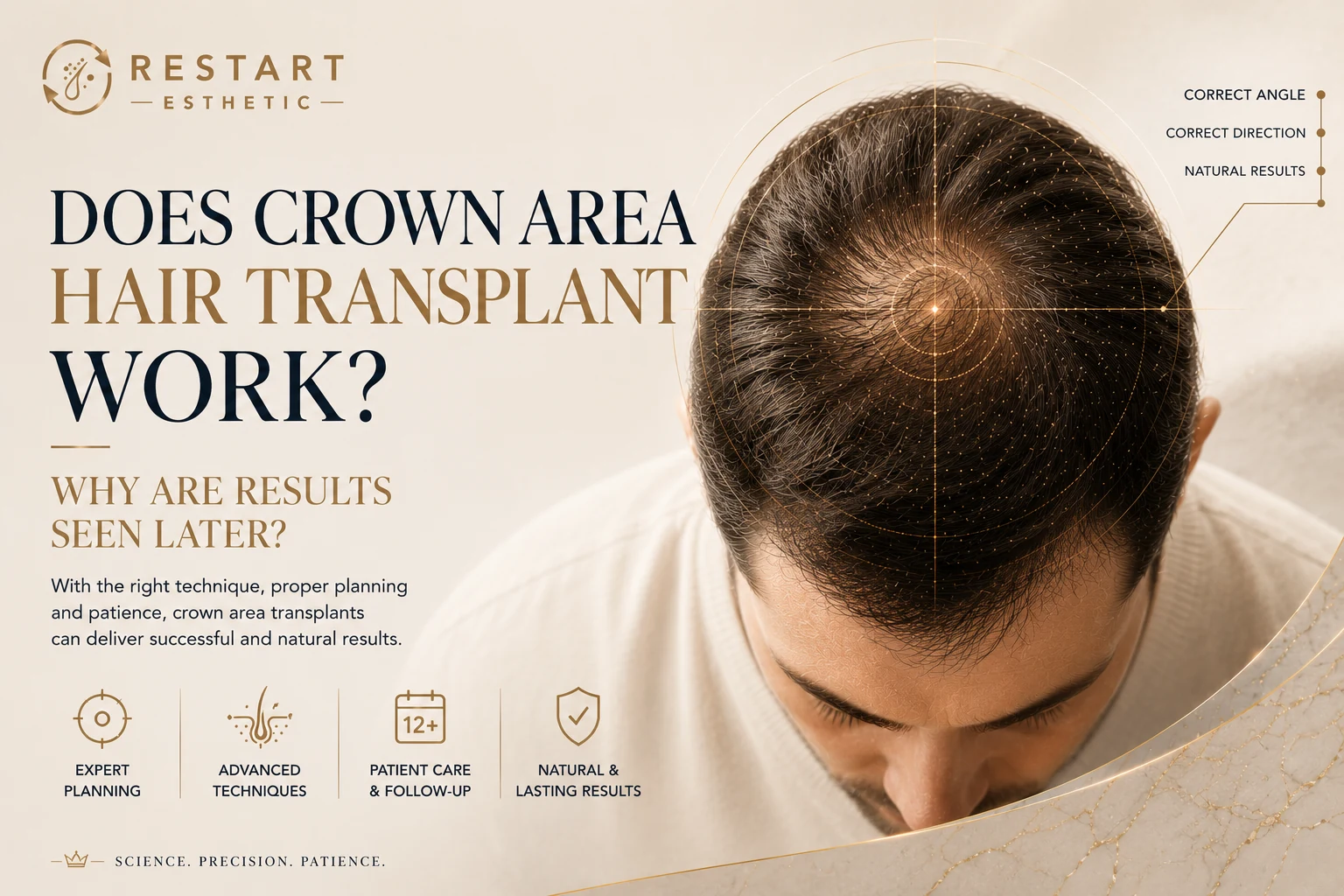
“Hair transplants do not take in the crown” is one of the most persistent beliefs in hair restoration — and one of the least carefully framed. The sentence is often built around a single photograph taken too early: the front has begun to look stronger, the crown still reflects light, and the patient assumes that one part of the operation has failed.
But the crown — also called the vertex — is not the frontal hairline moved to the back of the scalp. It is a circular area in which hairs do not travel in one shared direction. They radiate from a whorl. The same number of grafts may overlap and create strong coverage in the front, yet open into several directions at the crown. This means “Did the grafts survive?” and “Does the crown look dense enough?” are not the same question.
So let us set the rumour aside and ask the more useful questions: Does a crown hair transplant work, why can the result take longer to read, and which decisions genuinely shape a successful vertex restoration?
- Short answer: In a suitable candidate, healthy grafts can grow in the crown when they are protected and implanted correctly.
- Why the myth persists: The crown is circular, and hairs spread in different directions, so visual density develops differently from the front.
- Early photographs mislead: Sparse appearance in the early months does not prove that the grafts failed.
- What matters: Donor capacity, ongoing loss, graft survival, whorl direction and long-term planning.
- Graft count: There is no universal number; area, hair calibre and donor reserve must be calculated together.
- Final assessment: In some patients, crown texture and coverage continue to mature beyond month 12.
The short answer: yes, transplanted hair can grow in the crown
Hair transplantation rests on the principle known as donor dominance. Follicles taken from an appropriately selected safe donor area retain much of their biological character after they are moved. A healthy donor follicle can therefore produce hair in the frontal zone, the mid-scalp or the crown.
What makes the crown difficult is not an automatic biological rejection of grafts. The difficulty is geometric, aesthetic and longitudinal. The area may continue to expand, hairs radiate in multiple directions, and native hair around the transplant can keep miniaturising after surgery.
The word “take” can blur two different outcomes. A graft may survive biologically and produce hair, yet the crown may still look thin if direction, distribution or overall coverage was poorly planned. Graft survival and aesthetic density are not the same measurement.
Why do people believe crown grafts do not take?
1. The result is judged too early
Many visible shafts shed during the first weeks after surgery. This does not necessarily mean that the follicle has been lost. The visible hair falls while the follicle beneath the skin prepares for a new cycle. When early growth begins, the frontal and crown zones are not required to appear at the same time, with the same calibre or with the same visual strength.
A crown photograph taken at month six or eight may still show the middle of the journey. When that image is treated as final, “it did not take” becomes an easy conclusion. Yet calibre, length and the visual cooperation of hairs inside the whorl may need a longer window to mature.
2. The crown is a circular area that quietly consumes grafts
The frontal region is often planned as a band or a tapered shape. Hairs move forward and sideways, layering over one another and creating more coverage than the raw density alone would suggest. The vertex is circular. A modest increase in diameter can create a meaningful increase in total surface area.
The hairs also do not behave as though they were combed in one direction. Because they radiate from the centre of the whorl, each graft may expose light in a different direction rather than covering its neighbour. This is why the crown is sometimes called a “black hole” in hair restoration literature: not because it is inherently unsuccessful, but because it can quietly consume a limited donor supply.
3. Continuing native hair loss is mistaken for graft loss
If the crown is thinning rather than completely bare, grafts are implanted among existing miniaturised hairs. The transplanted follicles may grow while androgen-sensitive native hairs continue to thin. When the area looks more open several years later, the change is not always the loss of transplanted grafts; it may be the continuing journey of the surrounding native hair.
This is why pre-operative trichoscopic assessment matters. The recipient area's miniaturisation must be read as carefully as the donor reserve. A plan that fills today's opening but ignores tomorrow's loss may look convincing in year one and fragmented later.
4. Grafts are distributed by empty space rather than by visual purpose
Treating the crown as a blank circle ignores the whorl centre and the natural flow of hair. A mathematically even distribution is not always an aesthetically even one. If the centre, transition zone and existing directions are not read together, the result can form an artificial star pattern — or remain weak under light despite an apparently adequate graft count.
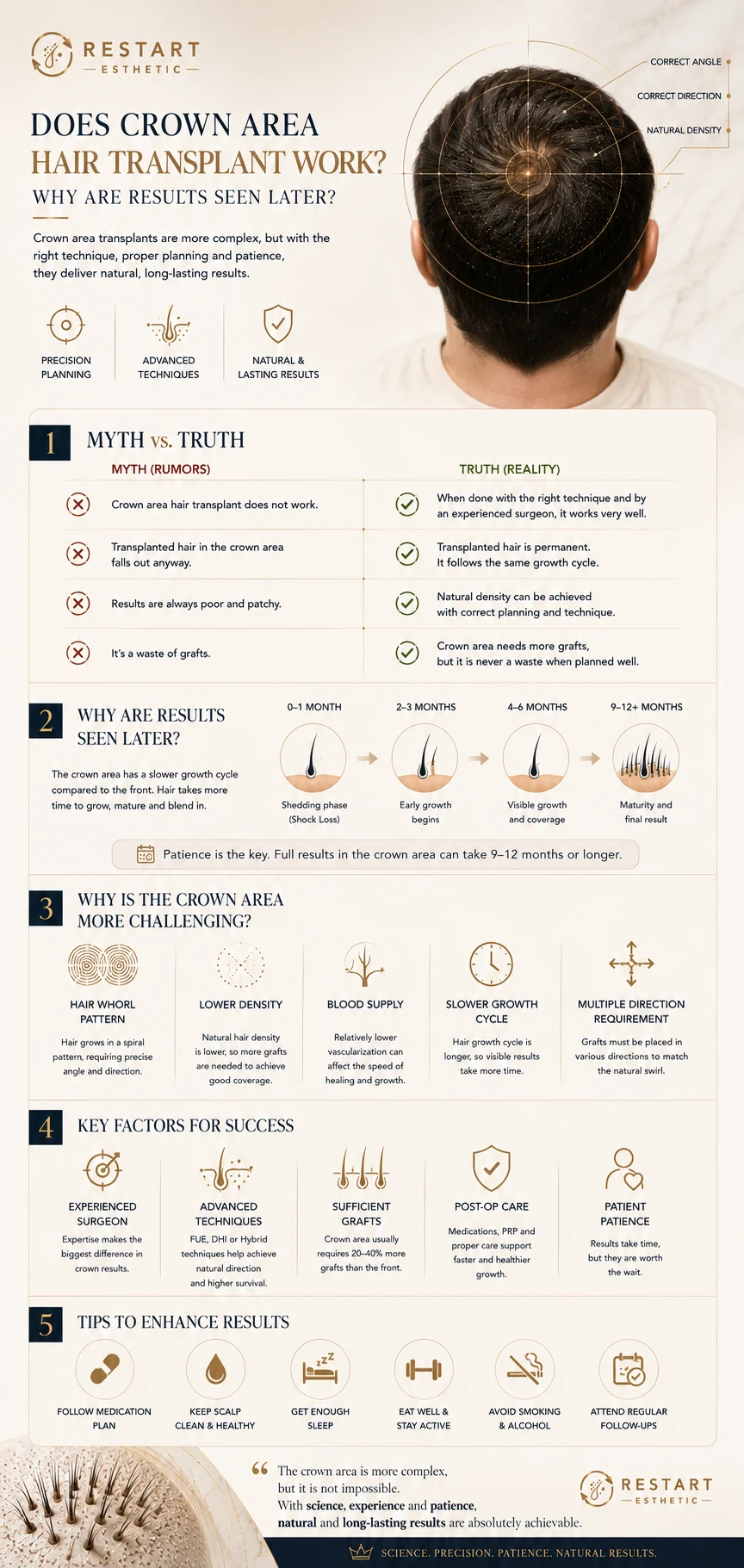
The crown has its own architecture: a whorl is more than a direction
Natural crown hair may rotate clockwise or counter-clockwise around a single centre. In some people the centre sits away from the midline; in others, two distinct whorls are present. There is no universal vertex template that can simply be copied from one patient to the next.
Planning begins by reading the direction of the remaining hair. The centre is located, the flow leaving that centre is preserved, and recipient sites are created as a continuation of that movement. The aim is not to draw a perfect circle. Natural hair is not a clean graphic; it is controlled irregularity, and its realism lives in those small variations.
Directional error is especially visible in the crown. A graft may live, but if it grows against its neighbours it separates during styling, reflects more scalp and begins to look implanted. In vertex work, direction is therefore part of survival's visible meaning. We explore this regional relationship more technically in our guide to channel angle and hair direction in Sapphire FUE.
“Success in the crown is not filling an empty circle with hair. It is rebuilding the movement that hair carried there from the beginning, without exhausting the donor that must serve the future.”Restart Esthetic Editorial
What actually determines crown graft survival and appearance?
Correct candidacy
A healthy scalp, a sufficient and stable donor area, a well-understood pattern of loss and realistic expectations are the foundation. If diffuse thinning involves the donor zone, or if an active scalp disorder is suspected, the correct first step is not to book surgery. It is to clarify the diagnosis.
Using the donor for the future, not only for today
The donor area is finite. The frontal hairline, mid-scalp and crown all draw from the same reserve. Every graft used in the vertex today is unavailable for future progression elsewhere. Aggressively filling the crown in a young patient whose loss is still changing may be attractive in the short term and unbalanced in the long term.
Protecting the graft outside the body
A graft assigned to the crown has no biological disadvantage compared with one assigned to the hairline. Both are vulnerable to extraction trauma, drying, unnecessary handling and prolonged time outside the body. We examine this invisible layer in our tired graft article: living tissue must be protected before it ever reaches the correct destination.
Using the right follicular unit in the right place
Single-, double- and multi-hair follicular units do not perform the same visual task. Softer units may support transitions while stronger units build coverage where it matters. The target is not density per square centimetre in isolation; it is optical density created by calibre, curl, hair-to-skin contrast and exit direction working together.
How many grafts does a crown hair transplant need?
There is no responsible answer without examining the patient. Statements such as “2,000 grafts are enough for the crown” turn personal planning into a convenient number. The requirement depends on:
- The diameter and total surface area of the opening,
- Whether the centre is bare or diffusely miniaturised,
- Hair calibre, curl and hair-to-skin colour contrast,
- Donor follicular-unit density and hairs per unit,
- The present and future needs of the front and mid-scalp,
- Whether a single session or staged plan is safer.
The better question is not “How many grafts can fit?” but “Which distribution creates meaningful optical density without spending the donor's future?” More grafts do not automatically mean a better result. Sometimes they only mean a faster loss of reserve.
Front or crown? Sometimes the right decision is to prioritise
In extensive hair loss, every zone may not be restored at equal density. The frontal hairline and mid-scalp often take priority because they frame the face, dominate the frontal view and allow hairs to layer. The crown can then be treated more conservatively according to reserve and expected progression.
This does not make the crown unimportant. It means that good planning balances visible impact with donor safety instead of sacrificing one zone to another. One patient may be treated in a single session; another may leave the vertex for a later session; a third may need stabilisation and observation before surgery becomes sensible.
A crown transplant is not judged only by its month-12 photograph. It is judged by whether the architecture still makes sense five and ten years later. A good plan covers today's opening while leaving room for tomorrow's loss.
When does a crown hair transplant result become visible?
The early healing phase resembles other recipient zones: crusting, redness and the first washes. Then comes the quiet interval in which transplanted shafts shed. But reading the crown requires more than counting emerging hairs. The shafts must gain length and calibre, then begin to support one another visually inside the whorl.
- First 10 days: The goal is not density; it is protecting newly placed grafts.
- Weeks 2–8: Transplanted shafts may shed. This phase should not be read as failure.
- Months 3–6: Early growth becomes visible; hairs may be fine and irregular.
- Months 6–12: Calibre, length and coverage develop meaningfully.
- Months 12–18: In some patients, vertex texture and optical density continue to mature.
This is not a guarantee calendar. Age, hair cycle, shaft characteristics, surgical technique and individual healing all affect the pace. Follow-up based on your own photographs and clinical examination should guide interpretation.
When might a crown transplant be the wrong decision?
A careful clinic does not recommend surgery for every visible opening. It may be wiser to investigate, stabilise or postpone when:
- Hair loss is active and progressing rapidly,
- The donor shows significant miniaturisation or diffuse thinning,
- Too little reserve would remain for future frontal and mid-scalp needs,
- An inflammatory or scarring scalp disorder is suspected,
- The expected density exceeds what the natural donor can provide,
- The patient expects the early months to look like the final result.
“Not now” does not always mean “never.” Sometimes the right order is diagnosis, stabilisation and only then surgical planning. Surgical discipline is not merely knowing what to do. It is also knowing when not to do it.
Conclusion: the crown does not “fail” by definition — it must be read differently
Healthy grafts can survive in the crown and produce lasting hair. But the vertex does not share the frontal zone's geometry, visual layering or evaluation rhythm. Its result must be read with more patience, separating graft survival from native-hair progression and optical density.
The real question is not simply, “Can hair be transplanted into the crown?” It is this: Do your donor reserve, loss pattern and natural whorl allow a vertex plan that will still make sense years from now? That answer can only be personal.
References
- Mysore V et al. Hair Transplant Practice Guidelines. Journal of Cutaneous and Aesthetic Surgery. 2021;14(3):265–284.
- Patwardhan N, Mysore V. Logic of Hair Transplantation. Journal of Cutaneous and Aesthetic Surgery. 2018.
- Park JH et al. Predicting the Permanent Safe Donor Area for Hair Transplantation According to the Position of the Parietal Whorl. Archives of Plastic Surgery. 2014.
- International Society of Hair Restoration Surgery. Crown Area and Recipient Area Terminology. ISHRS Patient Glossary.
- Ho A et al. Treatment Options for Androgenetic Alopecia: Efficacy, Side Effects, Compliance, Financial Considerations, and Ethics. Journal of Cosmetic Dermatology. 2022.
- Issa NT, Tosti A. Trichoscopy for the Hair Transplant Surgeon. Indian Journal of Plastic Surgery. 2021;54(4):393–398.
This article is for educational purposes and does not replace personal medical advice. Hair transplant candidacy, diagnosis, medication and surgical planning should be assessed by a qualified dermatologist or hair-restoration physician.
Frequently Asked Questions
Does a crown hair transplant work?
Why does crown hair transplant growth look slower?
How many grafts does a crown transplant need?
When is a crown hair transplant result final?
Will a crown hair transplant need a second session?
Why is the crown harder to cover than the hairline?
Let us read your crown through your own map, not through a rumour.
AI Hair Lab makes the boundaries of thinning, donor capacity and loss pattern more visible. You enter a specialist consultation with your own data, not only the question “Will it take?”
Start AI Hair Lab